Why a Six-Hour Ragù Tastes Different (And How To Fake Four Of Those Hours)
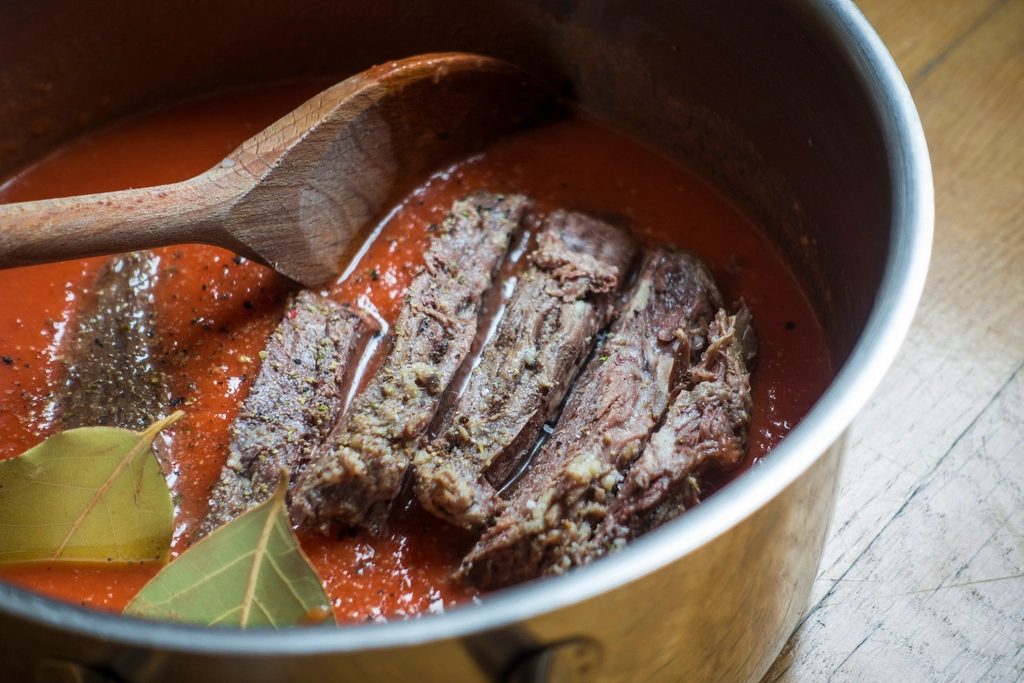
People talk about a long cook as if it were patience for its own sake. It is not. Six hours does three separate, measurable jobs, and once you know which is which you can work out exactly which corners are safe to cut on a Wednesday.
Job one: collagen becomes gelatin
Connective tissue starts converting to gelatin at about 68°C, but slowly. Hold a pot at 92–96°C and the conversion runs for hours; that dissolved gelatin is what makes a good ragù coat the back of a spoon and cling to pappardelle instead of sliding off into a puddle. It is texture, not flavour, and it is the reason a ragù made from lean 5% mince is disappointing however long you cook it. There is nothing in lean mince to convert.
This is the most fakeable of the three jobs. Choose the cut instead of the clock: coarse-minced beef shin, pork shoulder, or a quarter of oxtail dropped in whole and shredded later. Shin at 95°C is gelatinous in about two hours. In a pressure cooker at 1 bar — roughly 115°C — it is there in forty-five minutes.
Job two: water leaves
A ragù at hour one is a wet thing. By hour six it has lost something like a third of its volume, and every flavour in it is therefore half again as concentrated. Most home cooks defeat this entirely by putting a lid on, which turns a reduction into a stew: the water condenses, runs back down, and the pot holds steady at exactly the dilution it started with.
Cook it uncovered, or with the lid ajar on a wooden spoon. And this is the second fakeable hour — start from something already reduced. Our Slow Red has had six hours of open-pan evaporation done to it before it ever reaches the jar, which is precisely why a spoonful of it behaves like a much older pot than the one on your hob.
Job three: the reactions you cannot rush
The unfakeable one. Over hours at low heat, Maillard reactions continue slowly in the fond at the bottom of the pan; proteins break down into free amino acids; sugars from the soffritto caramelise gently. What comes out is a set of compounds that are not present at hour two at any temperature, because heat is not the variable — time is. This is why a pressure-cooked ragù can be perfectly tender and still taste young.
You can imitate the effect, though, by borrowing depth from ingredients that have already had time spent on them. A parmesan rind dropped in at the start. A teaspoon of fish sauce or a knob of Anchovy Butter Base stirred in at minute twenty — nobody tastes anchovy, everyone tastes savouriness. A spoonful of tomato paste fried in the fat until it turns brick-coloured, which takes three minutes and is the highest-return step in this whole article.
The order that matters
- Brown the meat properly, in batches. A crowded pan steams. Dry the meat, get the pan hot, accept that this takes twelve minutes rather than four.
- Soffritto by weight: 2 parts onion, 1 carrot, 1 celery. Twenty minutes on low, not eight. You are looking for translucent and sweet, not coloured.
- Fry the tomato paste until brick. Three minutes. Smell it change.
- Wine in, reduced to almost nothing. If it still smells of alcohol, it is not ready for the tomato.
- Then the tomato, then the milk. Milk sounds wrong and is not: lactose browns, and calcium tenderises. A splash at the start, not a splash at the end.
- Uncovered, 92–96°C, stir every half hour. If it is bubbling energetically, the heat is too high — you want a lazy blip every few seconds.
The fourth hour you get for free
Make it the day before. Cooling and reheating does something real: fat solidifies and redistributes, starch and gelatin set into a network, and volatile harsh notes escape overnight. Day two is not folklore, it is the cheapest hour on this list. Cool it in a wide tray so it drops below 20°C within two hours rather than sitting warm in a deep pot, which is both a food-safety point and a texture one.
The last thirty seconds
Drain the pasta a minute early, finish it in the sauce with a ladle of starchy water and a large handful of grated pecorino, off the heat, moving constantly. The starch and the cheese emulsify the fat that has been sitting on top of your pot for six hours. Skip this and you have a good sauce next to some pasta; do it and you have one dish. No amount of extra simmering substitutes for that half a minute.
So: the honest shortcut
Coarse shin instead of lean mince, a jar of already-reduced tomato, a parmesan rind and an anchovy for borrowed depth, cooked hard for ninety minutes uncovered and then left overnight. That is roughly two hours of work and it lands about eighty percent of the way to a six-hour pot. The remaining twenty percent is genuinely only available to people who stay in on a Sunday, and once a month or so, we think that is worth doing.