Toasting Whole Spices: The 90 Seconds That Change Everything
If you only ever change one habit in your cooking, change this one: buy whole spices, toast them in a dry pan for a minute or two, and mill them yourself. It costs nothing, it takes ninety seconds, and it is a bigger jump in quality than any pan or knife you could buy.
What toasting actually does
A cumin seed is a small package of volatile aromatic oils held inside cell walls. Cold and whole, almost none of that reaches your nose. Heat does three things at once: it thins those oils so they migrate to the surface, it drives off the tiny amount of residual moisture that makes ground spice taste flat and dusty, and — above roughly 140°C — it starts Maillard and pyrolysis reactions that create entirely new compounds. Toasted cumin is not louder cumin. It is a different flavour, nuttier and rounder, which is why the raw and toasted versions are not interchangeable in a recipe.
That is also why pre-ground supermarket spice is dull rather than wrong. It was milled months ago in a factory, and volatile oils do what their name says. Ground spice loses most of its aroma within about eight weeks of milling. Whole seed holds it for a year or more.
Timings, by spice
Medium-low heat, dry pan, no oil, one variety at a time. These are the numbers we work to in the kitchen for a 40-jar batch and they scale down fine to a teaspoon.
| Spice | Time | You are waiting for |
|---|---|---|
| Cumin seed | 90 seconds | A sharp nutty smell, one shade darker, first seed jumping |
| Coriander seed | 2 min 30 | Citrus turning to biscuit; they crackle audibly |
| Fennel seed | 2 minutes | Sweet anise, faint colour change only |
| Black peppercorns | 60 seconds | A hot, floral smell — pull before any smoke |
| Cardamom pods | 45 seconds | The pod paper goes brittle; eucalyptus in the air |
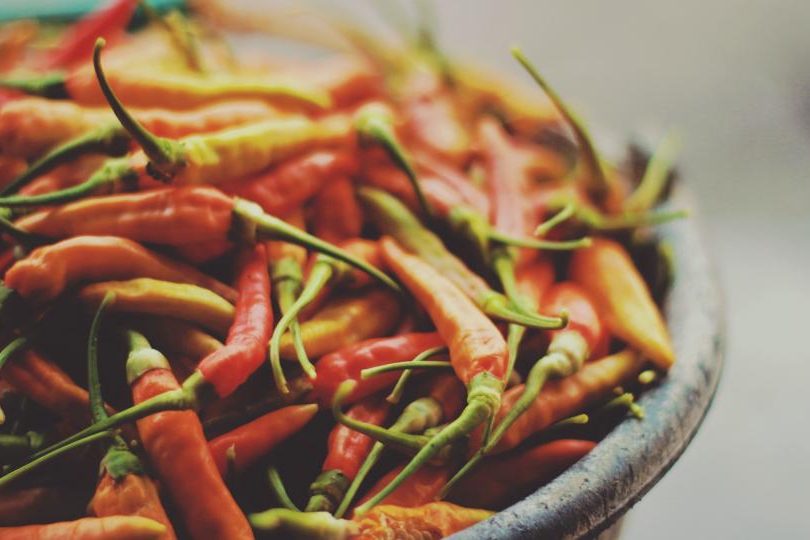
| Dried chillies | 20–30 seconds | They puff and go glossy. Go longer and the room becomes uninhabitable |
| Cassia or cinnamon bark | 30 seconds | Barely anything. Bark is mostly there for the mill |
| Mustard seed | Do not toast dry | It turns bitter. Bloom it in fat instead |
The fifteen-second window
Cumin gives you about fifteen seconds between correct and acrid. That is the whole difficulty. Two rules make it survivable:
- Judge by smell, not colour. By the time a seed has visibly darkened it is a second from too far. Your nose is faster than your eyes here.
- Tip it out immediately, onto a cold tray. A hot pan carries enough residual heat to burn spice after the gas is off. Leaving it in the pan “to cool” is the single most common way people ruin a batch.
Burnt spice tastes of ash and bitterness with no sweetness underneath, and it does not hide in a dish — it dominates. If you are unsure, taste one seed. Bin the batch if it is wrong; you are throwing away thirty cents and rescuing a dinner.
Then: cool completely before you mill
This is the step almost nobody knows and the reason home-milled blends sometimes taste muddy. Warm spice has mobile, sticky oils. Put it through a mill warm and those oils smear into a paste on the burrs, which does two things: it clogs the mill, and it means what comes out is partly a paste rather than a powder. Spread the toasted spice on a cold plate, wait five minutes until it is genuinely room temperature, then mill.
Burr over blade, if you have the choice. A blade grinder chops, producing dust and gravel in the same handful; a burr mill produces an even grind you can set coarse. We mill deliberately coarse enough that you can still see what is in the jar — a texture decision as much as a flavour one, because coarse spice keeps releasing over a long cook while dust gives everything up in the first five minutes.
Toasting is not blooming
Two different techniques, often confused. Toasting is dry, applies to whole spice, and happens before milling. Blooming is wet: ground spice into hot fat for twenty to thirty seconds at the start of a dish, so the fat-soluble compounds dissolve into the oil and distribute through everything. Ground turmeric, cumin and coriander all need blooming — dry from the jar into a finished dish they taste chalky. Anything with dried herbs, citrus peel or chilli flakes goes in at the end instead, because those burn.
Our own blends are built with this split in mind. Golden Hour wants thirty seconds in hot butter; Green Market wants to go in off the heat. It is printed on the label of both, because getting it the wrong way round is the most common reason a good blend disappoints.
Keeping it
- Toast what you need for a week or two, not a year. The gain decays.
- Lid on, away from the hob. Steam is what kills a jar, not time.
- Write the date on the lid. We print the milling date on every jar we sell for exactly this reason — a bare best-before tells you nothing about how alive the contents are.
If you would rather not stand over a pan every fortnight, that is what we exist for: toasted and milled weekly in 40-jar batches, dated on the lid. But do it yourself once, with cumin, and you will understand what you are buying.